.png)

In the healthcare industry, every second is vital. Hospitals and medical institutions operate in high-pressure environments where speed, precision, and hygiene are paramount, leaving no margin for error.
To support this system, single-use products such as gloves, wipes, and packaging are critical to supporting this aspect of healthcare.
They play an essential role in infection control and ensuring patient safety. However, the use of single-use items has a cost associated with it; in fact, millions of tons of waste are generated each year in healthcare, with plastics being a substantial portion of this due to plastics’ durability and sterility. As per the World Health Organization > WHO, around 85% of healthcare waste is non-hazardous, yet much of it is still discarded after a single use.
According to Health Care Without Harm, global healthcare systems contribute approximately 4.4% of worldwide greenhouse gas emissions, demonstrating how much of an ecological impact healthcare worldwide can have. As sustainable practices have become a major objective in healthcare, they now face a dual responsibility to maintain performance while reducing environmental impact.
In the UK, this challenge is particularly visible. The healthcare sector, primarily driven by the NHS, generates an estimated 133,000 tonnes of plastic waste each year, highlighting the scale of reliance on single-use materials within critical care environments.
At the same time, the NHS has set clear sustainability targets, including a 50% reduction in carbon emissions from waste management, alongside a commitment to significantly increase the recycling of medical plastic waste. This creates a clear challenge: balancing the need for high-performance, single-use products with the urgent need to reduce environmental impact.
When efficiency comes at an environmental cost
The dependency on single-use plastic-based products has led to a substantial rise in medical waste. While strict compliance frameworks ensure patient safety and infection control, the environmental impact is not always addressed with the same level of focus at an operational level.
On a worldwide scale, healthcare has been a significant contributor to global waste. A large amount of medical waste is created from plastic due to its durability, ability to remain sterile, and its cost-effective nature. While the World Health Organization has found that a large proportion of all medical waste is actually considered to be nonhazardous, a sizeable amount of waste is still treated like disposable products and discarded after one use. Studies, including those from healthcare without harm, indicate that plastic makes up a large fraction of healthcare waste streams and has been designed to be used only once.
This creates a critical gap.
The compliance frameworks that healthcare professionals have adopted are created to protect patients from harm and to ensure that the proper care provided to patients is safe. However, long-term sustainability will depend on the conscious decision-making process for utilizing materials beyond what is required by law. It is not about replacing existing systems; rather, it is about rethinking how we use materials within those systems.
The care that healthcare professionals are responsible for extends beyond the patients that they take care of. It also extends to an environment that supports long-term health.
Moving towards responsible hygiene solutions
At Bioguard, we believe that performance and environmental responsibility should go hand in hand. This belief has led us to examine how everyday hygiene products are designed and delivered and also how they are used within high-demand environments.
One such shift is the move from single-use containers to refill-based systems. Refill pouches allow for the continued use of reusable receptacles rather than disposing of the entire container at each cycle while significantly reducing the use of plastics while maintaining environmental standards of hygiene and performance.
Introducing Bioguard tub wipes refill systems
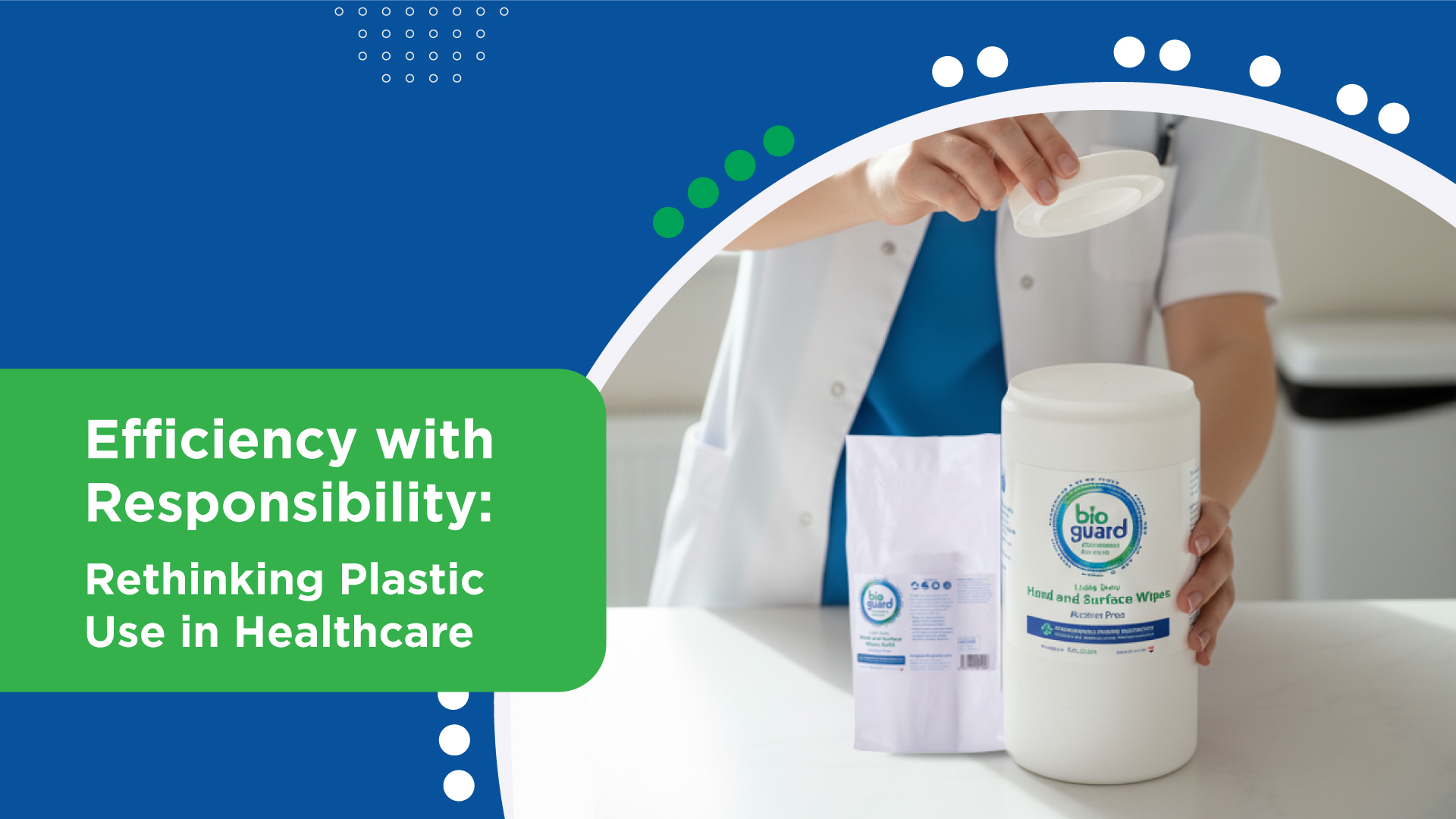
Bioguard HW240R Refill Pouch Light Duty Hand & Surface Wipes are a perfect example of this system; they are designed for high-volume usage, allowing customers to discard only the contents of their original tub when they need to refill, therefore cutting plastic waste up to 90% while continuing to provide a high level of protection.
Benefits of this approach include:
While this is a small change, it may have a substantial impact.
In healthcare, true sustainability does not require significant changes from current methods; at times, it begins with making everyday decisions that are more intelligent and responsible.
A conscious step forward
Despite growing awareness, only about 9% of all plastics created ever have been recycled successfully at best, signifying how critical it is to find ways to lessen our reliance on single-use materials versus just focusing on recycling these materials.
Healthcare has always been about responsibility: responsibility to patients, responsibility to people, and responsibility to society. As our understanding and expectations of healthcare evolve, so do these expectations and the requirement of accountability to those we serve.
When we talk about responsibility today, we must include an additional expectation beyond just providing safe and effective care; we must also begin to consider the cumulative effect of the daily decisions we make, which have a long-lasting impact on our environment and health.
By adopting solutions that not only promote institutional reliability but also contribute positively to the environment, institutions are able to make a larger contribution that extends beyond the immediate delivery of care. To see how Bioguard’s refill system works in practice, watch our demonstration here.
At Bioguard, we are committed to supporting the transition to an environmentally sustainable model by providing healthcare organizations with solutions that optimize care delivery performance while promoting sustainable practices, which save you money without sacrificing quality or performance.
If you are looking to reduce plastic waste without compromising on hygiene, safety, or operational efficiency, switch to Bioguard HW240R refill pouch light duty hand & surface wipes and make a smarter choice by reducing plastic waste by up to 90% without compromising on protection.
The Bioguard solution is a win-win for the environment and your pocket.
Leave Comments